Environmental education applied from the circular economy
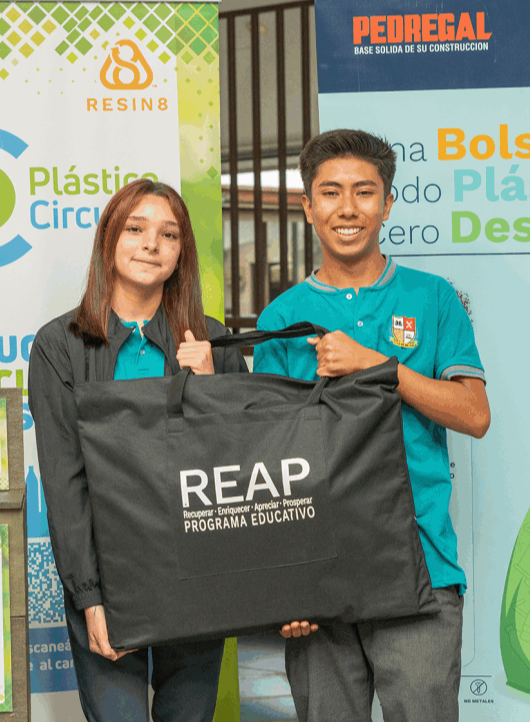
REAP and La Bolsa que Construye are environmental education programs developed and implemented by the CRDC Foundation in the canton of Belén as part of the Plástico Circular Belén project.
This case of Belén demonstrates how education, when connected to the applied circular economy, can generate real transformations in students, families and communities.
Here, learning does not stay in the classroom: it becomes action, citizen participation and measurable environmental impact.
Environmental education for the circular economy and regeneration
The REAP program was born as a response to a global problem: plastic is a multigenerational pollutant, with direct impacts on ecosystems, human health, climate change and economies.
Faced with this challenge, the CRDC Foundation promotes a regenerative philosophy, based on the creation of an industrial symbiosis: the plastic waste generated by some activities becomes raw material for others, optimising resources, reducing waste and promoting circularity.
In Belén, this vision translates into applied education: the plastic that the community recovers is transformed into RESIN8™, an aggregate used in the construction industry, closing the cycle between environmental training and sustainable productive development.
REAP is an eco-literacy program that seeks to instill this regenerative philosophy through a pedagogical route of: LEARNING → REFLECTION → ACTION
Its objective is to reduce plastic pollution by forming environmental criteria from an early age. Each educational center defines a specific grade where the program is taught permanently, guaranteeing continuity year after year:
• Elementary: Commonly in fourth grade
• Academic High School: Seventh Year
• Technical Colleges: Tenth Year
Thus, each generation that reaches that level takes REAP as part of its regular educational process.
The CRDC Foundation's pedagogical team directly trains teachers and professors in the contents of the program and provides accompaniment throughout the year. This ensures consistent implementation and leaves capacities installed in each educational center, consolidating the program as part of the regular training process.
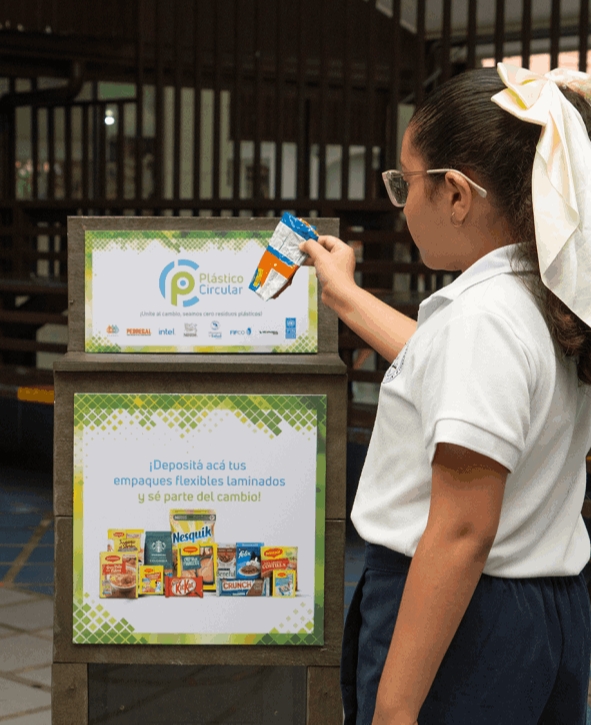
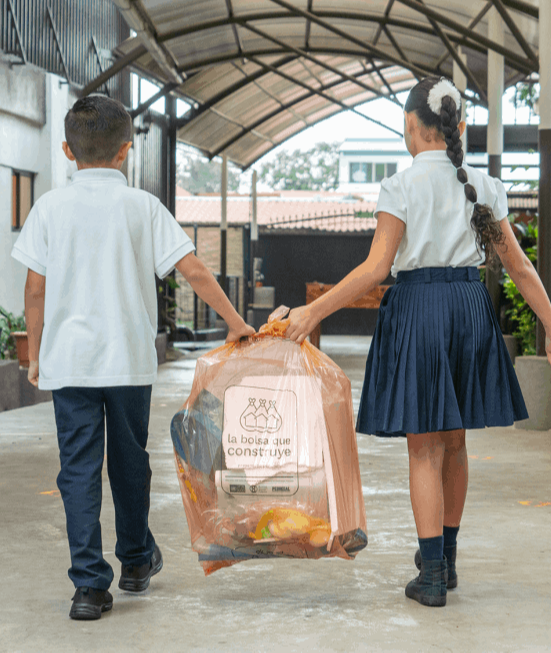
Once the theoretical training with REAP has begun, La Bolsa que Construye is activated, generally between May and November, when students already have the necessary awareness to correctly separate plastics that are not recyclable by traditional systems, but can be processed in RESIN8™.
Each educational center defines its scope, some activate the program throughout the center and others only in the grades where REAP is taught.
The process includes:
• Plastic collection per classroom
• Weighing each bag
• Registration in control logs
• and healthy competition between groups
The classroom that recovers the most plastic receives an award at the end of the year, benefiting both students and the institution. This approach strengthens teamwork, co-responsibility and the sense of collective achievement.
The Circular Plastic Belén project has an electric truck that makes weekly routes to collect the material recovered in educational centers. This waste is transferred to the plant to be transformed into RESIN8™, preventing it from remaining for hundreds of years contaminating landfills or the environment. Thus, children and young people can see how their efforts are converted into concrete solutions within the circular economy.
Educational impact in Bethlehem
2024 Results
• 6 participating schools
• 700 students trained
• 2,800 students involved in collection
• 17 tonnes of plastic recovered
2025 Results
• 9 participating schools
• 4,628 students reached
• 1,350 students trained
• 104 teachers trained
• 319 parents trained
• 2,855 students involved in collection
• 24 tonnes of plastic recovered